
Commuting E-Bikes: Everything You Need to Know Before Using One

Commuting e-bikes for daily travel are becoming a serious alternative for people tired of stressful commutes. If you’ve ever wondered whether an e-bike actually makes daily commuting easier or just adds another thing to manage, you’re not alone.
Daily commuting is draining mentally, physically, and financially.
Traffic crawls. Fuel prices rise. Public transport is crowded and unpredictable. And by the time you reach work, you already feel tired.
So it’s no surprise that more people are quietly asking:
“Would an e-bike actually make my daily commute easier?”
Not faster in theory.
Not cheaper on paper.
But practically, in real life.
This guide is written for beginners who want clear, honest answers no hype, no selling just a realistic look at whether commuting e-bikes make sense for everyday travel.
1. What Exactly Is a Commuting E-Bike?
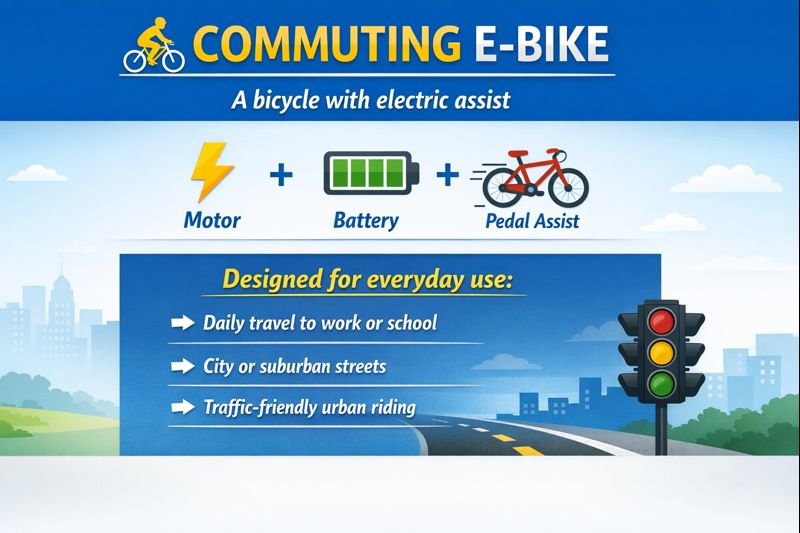
A commuting e-bike is simply an electric bicycle built for daily, repeated travel to the office, college, errands, or city rides.
At its core, it combines three things:
- A battery
- An electric motor
- Pedal assistance (or throttle, in some models)
You still pedal.
You’re still riding a bicycle.
But the bike helps you when effort becomes a barrier.
That assistance matters most when:
- Traffic forces frequent stopping
- Distances feel “just a bit too far”
- Slopes and flyovers drain energy
- You want to arrive without sweating through your clothes
Think of a commuting e-bike as cycling without the worst parts of cycling.
2. How Do E-Bikes Actually Work for Daily Commutes?
E-bikes don’t replace pedaling they support it.
Here’s what happens in real life:
- You start pedalling
- The motor adds power based on your effort
- The battery supplies energy to the motor
- Assistance cuts off after a set speed (based on local laws)
What this means for commuters:
- You accelerate smoothly from traffic lights
- You maintain a steady speed with less effort
- Hills feel flat
- Commute time becomes more predictable
Many commuters describe e-bikes as the middle ground between a bicycle and a motor vehicle without the costs or stress of either.
3. Are E-Bikes Actually Good for Daily Commuting?
E-bikes are a great fit if:
- Your commute is 5–30 km
- You travel through busy city roads
- You want to reduce fuel or cab expenses
- You value consistency over speed
They may not be ideal if:
- You travel extremely long distances daily
- You rely on high-speed highways
- You have no safe place to park or charge
Once people realize an e-bike could work for their commute, the next question usually becomes which types of e-bikes are actually built for daily city travel.
4. E-Bike vs Car for Commuting (Reality Check)
| Factor | E-Bike | Car |
| Daily cost | Very low | High |
| Traffic | Easy to navigate | Constant delays |
| Parking | Almost anywhere | Stressful |
| Commute time | Predictable | Unpredictable |
| Stress level | Low | High |
In cities, e-bikes often don’t just save money they save time and mental energy. Not all e-bikes feel the same on the road some are built specifically to handle stop-and-go traffic, longer distances, and daily use.
5. E-Bike vs Regular Bicycle for Daily Commute
| Factor | E-Bike | Regular Bicycle |
| Effort required | Assisted | Full effort |
| Sweat level | Low–moderate | High |
| Long distances | Comfortable | Exhausting |
| Daily consistency | High | Depends on fitness |
E-bikes remove the biggest reason people quit cycling: arriving tired, sweaty, or demotivated.
Battery size, motor type, and riding posture can change the experience completely, which is why commuters usually compare models before choosing one.
6. How Far Can You Realistically Commute on an E-Bike?
Most commuting e-bikes offer:
- 40–80 km per charge (depending on terrain, rider weight, and assist level)
In daily use:
- 5–15 km → effortless
- 15–30 km → very common
- 30+ km → possible with planning
Charging is simple—usually 3–6 hours.
Most commuters just plug in overnight or at work.
7. Is an E-Bike Worth It for Office Commuting?
People who switch to e-bikes often notice:
- They arrive less tired
- They avoid fuel and parking costs
- They get light, consistent exercise
- Their commute becomes calmer
For many office workers, e-bikes replace:
- Short car trips
- Daily cab rides
- Crowded buses or trains
It’s not about speed, it’s about control over your day.
8. Pros and Cons of Using an E-Bike for Commuting
Pros
- Low running cost
- Environment-friendly
- Faster in traffic
- Less physical strain
- Predictable travel time
Cons
- Higher upfront cost than a regular bike
- Requires charging
- Battery replacement over time
- Needs good theft protection
Like any tool, it works best when used for the right job.
9. How Fast Do Commuting E-Bikes Go?
Most commuting e-bikes are designed for urban safety, not racing.
- Typical assist limit: 25 km/h
- Some regions allow up to 32 km/h
The goal isn’t speed, it’s steady, stress-free movement through traffic.
Is a Commuting E-Bike Right for You?
E-bikes aren’t a trend,d they’re a response to how modern cities work.
If your daily commute involves:
- Traffic congestion
- Short to medium distances
- Rising travel costs
- Commute fatigue
Then an e-bike can make commuting simpler, cheaper, and far less stressful.
At this point, most commuters have answered the big question.
Yes, an e-bike could work for my daily travel. What’s left is choosing one that fits distance, budget, and comfort.
E-bikes aren’t about speed or trends. They’re about removing friction from daily life.
If commuting feels unnecessarily exhausting or expensive, an e-bike may simply be the more practical option.
And when you’re ready to explore specific models, understanding how different commuting e-bikes compare makes the decision much easier.